
Picture a pan of oil heating on the stove for fries. You step away to answer a text, come back, and the surface is shimmering, then smoking, then there’s a small flame licking up the side of the pot. Your instinct is to grab the pan and move it to the sink, or throw water on it. Both of those are how a manageable stovetop fire becomes a kitchen-on-fire situation.
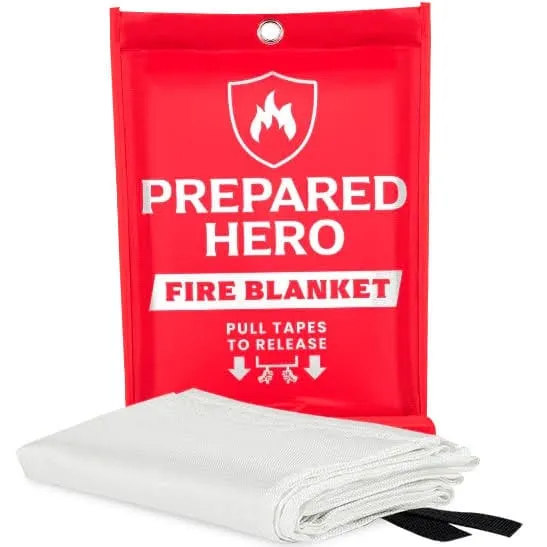
That two-minute window is exactly what the Prepared Hero Emergency Fire Blanket is built for. It’s a square of woven fiberglass you yank out of a wall pouch and drape over the flames. No pin, no aiming, no chemical cloud. We’ve seen it pop up all over Amazon and TikTok, so let’s talk about whether it actually earns the $15 to $20 it usually costs.
What the Prepared Hero fire blanket is, and who it’s for
It’s a flame-resistant blanket, roughly 39 by 39 inches (about 1 meter square), that smothers a small fire by cutting off its oxygen. You smother, the fire dies, you walk away. That’s the whole pitch.
Who it’s for: anyone with a stove, basically. Renters who can’t drill a giant extinguisher bracket into the wall, parents who want something a teenager can use without a tutorial, RV and boat owners, college kids in a dorm. If you cook with oil even occasionally, this belongs near (not over) the stove.
Who it’s not for: anyone hoping to fight a fire that’s already spread to the cabinets or the walls. This is a “first 60 seconds” tool, not a firefighting kit.
How a fire blanket actually works
Fire needs three things: heat, fuel, and oxygen. A fire extinguisher attacks the chemistry of the flame; a blanket just takes away the oxygen by sealing the fire off from the air. Lay it flat over the flames and the fire suffocates.
The big advantage over a kitchen extinguisher is mess. A dry-chemical extinguisher coats your entire kitchen in a fine yellow powder that gets into everything, and that monoammonium phosphate residue is mildly corrosive, so it can pit stovetops and electronics if you don’t clean it fast. A blanket leaves nothing behind. You toss the burnt pan, you don’t repaint the kitchen.
The big disadvantage: a blanket only works on what it can cover. It has no reach. An extinguisher can hit a fire across the room.
Specs and materials
Here’s what you’re actually buying.
| Spec | Detail |
|---|---|
| Material | Two layers of woven fiberglass with a fire-retardant inner film |
| Size | ~39” x 39” (an XL version runs about 47” x 71”) |
| Weight | Just under 1 lb |
| Mounting | Fabric pouch with adhesive/hanging back and two easy-pull tabs |
| Standard cited | EN 1869:1997 (European fire blanket standard) |
The build is genuinely simple, which is the point. You hang the red pouch on a wall near an exit route from the kitchen, and when you need it you grab both tabs and pull straight down. The blanket slides out in one motion. No folding to fight with, no clasp to undo while a pan is on fire.
How to use it in an emergency
Speed matters more than technique here, but technique keeps your hands safe.
- Turn off the heat if you can reach the knob safely.
- Pull both tabs to free the blanket.
- Hold the top edge and roll your hands back to shield your knuckles from the flames.
- Lay the blanket over the fire, starting from the edge nearest you and laying it away from you. Don’t throw it; throwing fans the fire and can miss.
- Leave it in place. Walk away and let it sit at least 15 minutes so the pan cools before you lift anything.
What not to do: don’t use it on a fire that’s climbing the wall or the range hood, don’t use it on a person whose clothes are fully ablaze if a stop-drop-and-roll is faster, and never put a blanket back over a deep-fryer fire and then immediately move the fryer. Heat lingers. If the fire is bigger than the blanket, skip all of this, get everyone out, and call 911.
Real-world performance
Grease and oil fires are where this thing shines. This is the one fire where water is actively dangerous (it flashes to steam and sprays burning oil), so a Class K / Class F situation is the blanket’s home turf. Reviewers across Amazon, Home Depot, and Walmart consistently report it knocking down small pan fires fast.
Electrical fires, like a smoking toaster or a sparking outlet, are fine to smother once you’ve killed the power, since the blanket is non-conductive. Just unplug or flip the breaker first.
Clothing and upholstery fires are a real, underrated use. Wrapping someone whose sleeve caught, or smothering a sofa cushion that a candle lit, is something a blanket does well and an extinguisher does messily.
The honest catch: this is a one-pan tool. Once a fire outgrows the 39-inch square, the blanket can’t seal it, and you’re back to evacuation.
Pros, cons, and the reusability myth
What we like:
- Dead simple, no training needed
- Zero residue and non-toxic
- Works on the grease fire that water would make worse
- Cheap enough to put one in the kitchen, the garage, and the car
What we don’t:
- Small fires only, full stop
- “Reusable” is mostly a myth, treat it as one-time
That last point matters. Marketing loves to say these are reusable. Once a fiberglass blanket has been on a real fire, the fibers degrade, the retardant film can be compromised, and you have no way to verify it’ll seal next time. After any actual use, throw it out and replace it. At $15, that’s a non-issue.
Certifications, honestly
The packaging cites EN 1869:1997, the European standard for portable fire blankets (it was later updated to EN 1869:2019). That standard means a sample design passed a lab test smothering a pan of burning oil.
Two things to be straight about. There’s no single mandatory federal “fire blanket” certification in the US the way there is for, say, UL-listed extinguishers, so don’t read “CE marked” as a US government stamp. And a certification applies to the tested design, not to a guarantee about the individual unit in your hands. It’s reassurance, not a warranty.
Price and where to buy in 2026
As of mid-2026, single blankets run roughly $15, and two-packs land around $20 to $25 at Amazon, Home Depot, and Walmart. We’ve seen Walmart undercut Amazon on the multi-packs, so it’s worth a 30-second price check before you buy. Prices and pack configurations shift, so confirm the current listing before you check out.
One real caution: counterfeits exist. Buy from the brand’s own storefront or a major retailer, not a random third-party seller with no reviews.
Is it worth it? For the price of two coffees, yes, with the firm caveat that it’s a supplement, not your only line of defense.
Fire blanket vs. kitchen extinguisher: which should you own?
Both. They cover different failure modes.
| Fire blanket | Kitchen extinguisher (e.g. First Alert KITCHEN5, ~$25) | |
|---|---|---|
| Best at | Pan/grease fires, clothing, small contained flames | Fires you can’t reach to cover |
| Reach | Arm’s length only | Across the room |
| Mess | None | Powder everywhere |
| Reusable | No, replace after use | Often single-use too |
A blanket is faster and cleaner for the most common kitchen fire. An extinguisher handles the ones that have already spread. If you can only afford one this month, the blanket is the better grab-and-go for a stovetop. Then add the extinguisher next paycheck.
Building a complete home fire-safety kit
A blanket is one piece. A reasonable starter set, and a smart line item when you’re setting aside money for the unexpected, looks like this:
- Working smoke alarms on every level (test monthly, batteries yearly)
- One fire blanket in the kitchen
- A Class B:C or multipurpose extinguisher near the kitchen exit
- A carbon monoxide detector if you have gas appliances
- An escape plan everyone in the house actually knows
If you want to time the bigger purchases, our guide on when to buy almost anything covers when this category tends to go on sale.
A fire blanket won’t save your house from a fire that’s already in the walls. What it will do is stop the small one that starts on your stove from ever getting there, and for fifteen bucks hanging next to the range, that math works out fine.