
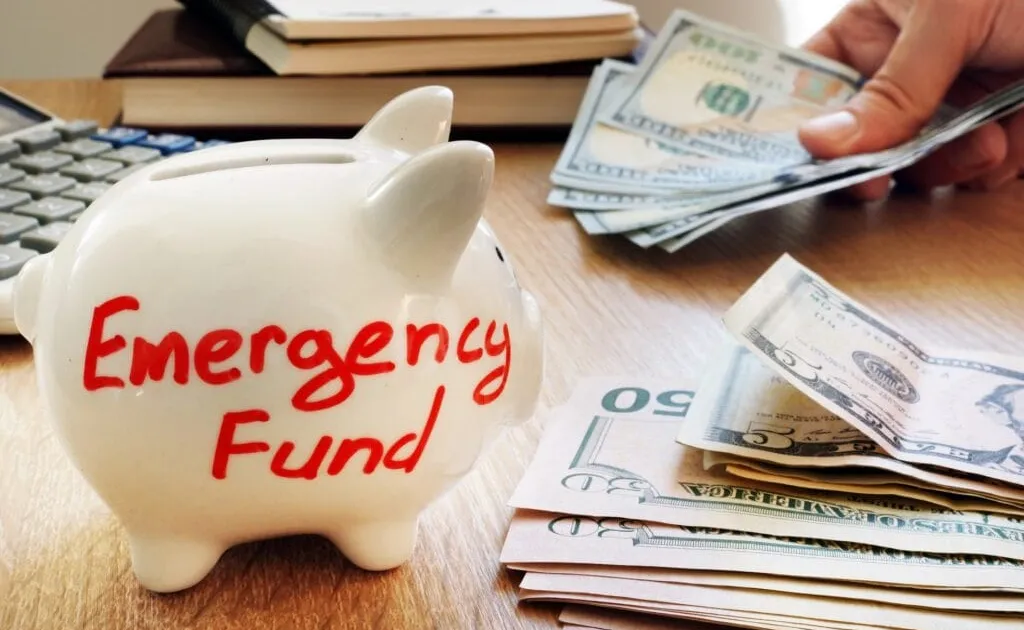
Your car breaks down on a Tuesday. The mechanic says $1,400. You don’t have $1,400. So you put it on a credit card, and now you’re paying 24% interest on a repair you couldn’t afford in the first place. That $1,400 becomes $1,700 over the next few months, and you’re still driving the same car.
That’s the cycle most people are stuck in. A 2024 Bankrate survey found that 56% of Americans can’t cover an unexpected $1,000 expense with savings. Not a $10,000 surprise. A thousand dollars. And the people in that position aren’t irresponsible — they’re just living in a system where one bad month can wreck six good ones.
An emergency fund changes that math. Not overnight, not magically, but it puts a floor under you so one unexpected bill doesn’t snowball into months of financial stress. Here’s how to actually build one, even if your starting balance is $0.
How Much Do You Actually Need?
You’ve probably heard the advice: save three to six months of expenses. That’s solid advice, and it’s also completely unhelpful if you’re staring at an empty savings account. Telling someone with $200 in the bank to save $15,000 is like telling someone who’s never run a mile to sign up for a marathon.
So let’s break it down into stages that make sense.
Stage 1: The Starter Fund — $1,000. This is your first real goal. A thousand dollars won’t cover a job loss, but it handles most of the emergencies that actually derail people: a car repair, a medical copay, a busted appliance, a last-minute flight home for a family emergency. Getting to $1,000 changes your relationship with money more than you’d expect. Suddenly you’re not one flat tire away from a credit card spiral.
Stage 2: One Month of Expenses. Add up your actual monthly costs — rent, utilities, groceries, insurance, minimum debt payments, transportation. Not your income, your expenses. For most people, this lands somewhere between $2,500 and $4,500. Getting to this number means you can survive a full month of lost income without borrowing.
Stage 3: Three to Six Months. This is the full safety net. Three months is enough for most single-income earners with stable jobs. Six months makes more sense if you’re freelance, self-employed, work in a volatile industry, or you’re the sole income for a household with dependents. You don’t have to get here fast. You just have to get here eventually.
| Stage | Target | What It Covers |
|---|---|---|
| Starter Fund | $1,000 | Car repairs, medical copays, minor emergencies |
| One Month | $2,500–$4,500 | One full month of essential expenses |
| Full Fund | 3–6 months | Job loss, extended illness, major life disruption |
Where to Keep It (This Matters More Than People Think)
Your emergency fund needs to be two things: accessible and earning something. A checking account is too accessible — it bleeds into daily spending. A CD or brokerage account isn’t accessible enough — you can’t wait five business days when your basement is flooding.
A high-yield savings account is the right answer for almost everyone. As of early 2025, the best HYSAs are paying between 4.00% and 5.00% APY, which is dramatically better than the 0.01% your regular bank is probably offering. On a $10,000 emergency fund, that’s the difference between earning $1 a year and earning $400-500.
A few accounts we’d point people toward:
- Marcus by Goldman Sachs — Consistently competitive rates, no fees, no minimum balance. Clean interface.
- Ally Bank — Good rate, excellent app, and their “buckets” feature lets you mentally earmark funds within one account.
- SoFi Savings — Currently one of the higher APYs available, though it requires direct deposit to qualify for the top rate.
- Discover Online Savings — Solid rate, backed by a well-known brand. No minimum balance or monthly fees.
The specific rate will shift over time — these accounts adjust when the Fed moves rates. What matters is picking an online bank that consistently pays 10x or more what the big traditional banks offer. There’s no reason your emergency fund should be earning 0.01% at Chase or Bank of America when you can move it to an online account in 15 minutes.
One rule we stick to: keep your emergency fund at a different bank than your daily checking account. The friction of having to transfer money between banks (usually 1-2 business days) is actually helpful. It prevents you from dipping into it for non-emergencies. You’ll think twice about transferring $300 for a weekend trip when it takes two days to arrive.
How to Actually Save When Money Is Tight
The hardest part of building an emergency fund isn’t knowing what to do. It’s finding money to put in it when your budget already feels stretched to its limit. We’re not going to tell you to skip your morning coffee. That advice is condescending and mathematically insignificant. Here’s what actually moves the needle.
Automate a small amount immediately. Set up an automatic transfer from your checking to your emergency fund on payday. Start with whatever feels almost painless — $25, $50, even $10. The amount matters less than the consistency. You adjust to having slightly less in checking within a week or two, and the fund grows without you thinking about it. We started at $50 per paycheck and barely noticed the difference.
Redirect one-time money. Tax refund? Birthday cash? A rebate check you forgot about? Side gig payment? These windfalls are the fastest way to build your fund because they’re money you weren’t counting on for bills. The average federal tax refund in 2024 was around $3,100. Dropping even half of that into an emergency fund gets most people past Stage 1 in one move.
Cut one subscription you don’t use. Not all of them. Just one. Most people are paying for at least one service they forgot about or barely touch. A streaming service at $15/month, a gym membership at $40/month, a software subscription at $12/month — that’s $67/month or $804/year that could go straight into your fund. Check your credit card statements from the last three months and look for recurring charges.
Sell something. This isn’t a long-term strategy, but it’s a real one-time boost. Old electronics, clothes you haven’t worn in a year, furniture collecting dust in the garage. Facebook Marketplace, eBay, Poshmark — pick one and spend a Saturday listing things. We cleared out a closet last spring and made $380 in two weeks. That’s a real chunk of a starter emergency fund.
Pick up one short-term side gig. Emphasis on short-term. You don’t need to become an Uber driver for life. But doing a few weekends of delivery driving, freelance work, or TaskRabbit jobs can generate $500-1,000 quickly. The money goes straight into the fund, and once you hit your target, you stop.
The Mistake Most People Make
Here’s where we see people go wrong: they build an emergency fund and then use it for things that aren’t emergencies.
A sale on furniture is not an emergency. A vacation deal is not an emergency. A concert you forgot was coming up is not an emergency. These are all real things, and some of them might even be worth spending money on, but they come from a different budget.
An emergency is an unexpected, necessary expense that you can’t avoid or defer. Car broke down and you need it for work. Medical bill from an ER visit. Your refrigerator died and your food is spoiling. You lost your job and need to cover rent this month.
If you find yourself constantly raiding your emergency fund for non-emergencies, the problem isn’t discipline. It’s that you need a separate sinking fund for irregular but predictable expenses — car maintenance, holiday gifts, annual subscriptions, home repairs. These are things you know are coming; you just don’t know exactly when. Put a small monthly amount into a separate savings bucket for these, and your emergency fund stays intact for actual emergencies.
What About Debt?
The “should I save or pay off debt” question comes up constantly, and the answer is more nuanced than most advice makes it sound.
If you have high-interest debt (credit cards at 20%+ APR), the mathematically optimal move is to pay that down before saving. But math isn’t everything. If you have zero savings and throw every dollar at credit card debt, you’re one car repair away from putting more on the card. You end up back at square one.
Our recommendation: build your $1,000 starter fund first, then attack debt aggressively. That first $1,000 acts as a buffer so unexpected expenses don’t push you further into the hole. Once you have that base, redirect your savings energy toward your highest-interest debt. After the debt is cleared, go back to building the emergency fund to the full three-to-six-month target.
Dave Ramsey has been saying this for years, and for all the valid criticisms of his approach, this particular piece of his baby steps framework is genuinely good advice. The psychological benefit of having some cash in the bank while you fight debt is real. It keeps you from feeling like you’re running on a treadmill with no safety net underneath.
When to Use It (and How to Refill It)
When a real emergency hits and you need to pull from the fund, don’t feel guilty about it. That’s literally what it’s for. The whole point of building it was so that when this moment arrived, you’d be ready.
But here’s the follow-up that people skip: start refilling it immediately. The day after you use your emergency fund, set up a plan to rebuild it. Go back to the automatic transfers, redirect your next windfall, tighten spending for a month or two. The goal is to get back to your previous balance as fast as reasonably possible.
We had to pull $2,200 from ours last year for an unexpected medical bill. It stung, but it didn’t go on a credit card, and we didn’t pay a cent of interest on it. Took about four months to build it back. That’s the system working exactly as designed.
Stop Overthinking the Starting Point
The biggest barrier to building an emergency fund isn’t the math. It’s the feeling that $25 or $50 at a time is pointless when you need thousands. It’s not pointless. It’s the only way most people get there.
A $50 automatic transfer every two weeks puts $1,300 in your account in one year. That’s past Stage 1 without doing anything heroic. Bump it to $100 when you can, redirect a tax refund, sell some stuff you don’t use — now you’re looking at $3,000-4,000 by the end of the year. That’s real money between you and a financial disaster.
You don’t have to be perfect at this. You don’t have to save a specific percentage of your income. You don’t have to follow anybody’s exact system. You just have to start putting money into a separate account on a regular basis and stop touching it unless something genuinely goes wrong. The account grows. The stress shrinks. And the next time your car makes a weird noise, you’ll be annoyed instead of panicked. That’s a better way to live.